Washed Does Not Mean Clean
We rinse our produce, buy organic, and feel like we have done the right thing. But the dirt we can see is not the part that should concern us most.


There is a version of clean that we have all grown up with. Dirt under your fingernails. Mud on a carrot pulled straight from the ground. The kind of thing you rinse off under the tap and it is gone. Visible, honest, and easy to deal with.
I grew up around that kind of dirt. Country dirt. Garden dirt. The kind that comes off with water and a little effort and leaves the food exactly as it should be — real, whole, and good.
That is not the kind of clean I am writing about today.
The Dirt We Cannot See
When I started thinking more carefully about what actually lands on our food before it reaches our kitchen, I had to sit with it for a while. Because the answer is not comfortable.
Produce travels. It is picked by hand — many hands. It is sorted, packed, loaded, unloaded, stacked, and handled at every stage of a supply chain that can span thousands of miles and dozens of people. It sits in warehouses. It moves through distribution centres. It is touched by workers who are doing their jobs quickly, in conditions that do not always allow for the kind of hygiene we might imagine.
By the time a bunch of grapes or a head of lettuce reaches the supermarket shelf, it has been breathed on, coughed near, sneezed over, and handled by more people than you will ever know. Not because anyone is careless. Simply because that is how food moves through the world.
And then it sits on the shelf. Where more people touch it, squeeze it, put it back. Where the air conditioning circulates whatever is in the air. Where it waits, sometimes for days.
Organic Does Not Change This
I want to be clear about something, because I think there is a widespread assumption that buying organic solves the problem.
Organic produce is genuinely better in many ways. Fewer synthetic pesticides. Better farming practices. A cleaner relationship between the soil and what grows in it. I buy organic whenever I can, and I think it matters.
But organic does not mean untouched. It does not mean handled by fewer people. It does not mean the supply chain is shorter or the conditions more controlled. An organic strawberry travels the same roads, passes through the same warehouses, and sits on the same shelves as a conventional one.
The pesticide question and the handling question are two separate things. Organic addresses the first. It does not address the second.
What a Rinse Actually Does
A rinse under cold tap water removes some surface residue. It washes off loose dirt, some dust, and a portion of what is sitting on the outermost layer of the skin. It is better than nothing.
But water alone does not neutralise pesticide residue that has bonded to the surface wax of the produce. It does not reach into the tiny crevices of a strawberry or the folds of a leafy green. And it does nothing about the microbial load — the bacteria, the viruses, the residue of human contact — that has accumulated across the entire journey from field to your kitchen.
We rinse and we feel like we have done something. And we have. Just not as much as we think.
The Part That Changed How I Think About This
I am not writing this to frighten anyone. I am writing it because I think there is a gap between what we believe we are doing and what is actually happening — and closing that gap is worth something.
The countryside dirt of my childhood was never really the concern. A carrot pulled from your own garden, rinsed under the tap, is about as clean as food gets. The soil it grew in is alive and full of things that are good for you. The hands that pulled it are yours.
The concern is the invisible accumulation of a long, complicated journey. The residue of pesticides and wax coatings designed to make produce look better and last longer on a shelf. The microbial transfer from dozens of pairs of hands. The airborne particles that settle on an open display of fruit.
None of this is dramatic. None of it is going to make you acutely ill from a single meal. But it is cumulative. And for a body that is trying to stay well — that is working hard to keep inflammation low, to support the gut, to give the immune system what it needs — reducing that invisible load consistently, every day, is exactly the kind of small act that adds up.
What People Have Always Done — And Where It Helps
Before I get to what I use now, I want to be fair about the old remedies. Because some of them are genuinely useful, and I do not want to dismiss what people have been doing in their kitchens for years.
A vinegar soak — typically one part white vinegar to three parts cold water, produce left to sit for ten to fifteen minutes — does reduce some surface bacteria and loosens a portion of pesticide residue. Research supports this. It is meaningfully better than a plain rinse. The drawback is that it does not fully neutralise residue that has bonded into the wax coating on the skin of the produce, and if you do not rinse well afterwards, you can taste it.
A baking soda soak — about a teaspoon per two cups of cold water, soaking for twelve to fifteen minutes — is actually the most studied of the home methods. A 2017 study from the University of Massachusetts found it removed more pesticide residue than plain water or a bleach solution. It works by breaking down certain pesticide compounds through an alkaline reaction. It is a genuinely good option if you do not have anything else.
Cold or iced water is worth knowing about for a different reason. It does very little for pesticide or microbial removal beyond a regular rinse — but it is excellent for reviving leafy greens and herbs that have gone slightly limp, and for crisping produce before serving. A ten-minute soak in cold water with a few ice cubes will bring wilted lettuce or herbs back to life. That is a real and useful thing, just not a cleaning method.
So if you are using any of these — keep using them. They are not nothing. The vinegar and baking soda methods in particular are doing real work.
What they cannot do is neutralise the full range of pesticide residue, wax coatings, and microbial load that accumulates across a long supply chain. They are manual, they take time, and the results are inconsistent depending on the produce, the concentration, and how long you soak. They are also not something most people do every single time — and consistency is where the difference is made.
What I Use Now
I started using the PurePod Produce Cleaner a few weeks ago, and it has become a quiet, non-negotiable part of how I prepare food.
The technology is called Oh-Ion — it uses ionisation to neutralise pesticide residue, wax coatings, and surface bacteria without any chemicals, sprays, or scrubbing. You fill a bowl with water, add your produce, drop in the PurePod, press the button, and let it run for a few minutes. That is it.
What comes out of the water is not something I will describe in detail. But it is enough to make you understand that what you were eating before was not as clean as you thought.
I use it on everything now. Berries. Leafy greens. Apples. Grapes. The things I used to rinse quickly and consider done. The difference is not visible on the produce — it looks exactly the same. But knowing what has been removed changes how I feel about what I am putting on the table.
It is compact, rechargeable, and simple enough that it has genuinely become part of the routine rather than an extra step I have to think about. I keep it next to the sink. It takes no more time than a rinse used to.
A Gift Worth Giving — Including to Yourself
I have been thinking about this as a gift lately — and I mean that seriously, not in the way that wellness products are reflexively called gift-worthy.
If you have someone in your life who cooks carefully, who thinks about what goes into their body, who buys organic and reads labels and tries to do the right thing — this is the piece they are probably missing. Not because they are not paying attention. But because the gap between "washed" and "clean" is not something most of us were ever taught to think about.
Giving someone the PurePod is giving them the last step in a process they have already started. It is saying: you already care about this, and here is something that takes that care all the way to the end.
For a birthday. For a housewarming. For a mother who cooks for her family every day and deserves to know that what she is putting on the table is as clean as it can possibly be.
And honestly — do not wait for an occasion to give it to yourself. We are often the last person we think to care for in that deliberate, intentional way. But you are in your kitchen every day. You are the one preparing the food. You are the one who has already made the effort to buy well and cook thoughtfully. This is simply the last step — and you deserve it just as much as anyone you would give it to.
It is a small thing that changes something real. Those are the best kinds of gifts — and the best kinds of things to do for yourself.
The Bigger Picture
I have written a lot on this site about the small, layered habits that make a difference over time. The morning water. The evening tea. The honey. The things that do not look like much individually but that, done consistently, shift something in how your body feels and functions.
This fits into that same philosophy. It is not a dramatic intervention. It is one more small act of care — applied to something we do every single day, multiple times a day, without thinking about it.
We eat. We feed the people we love. And the quality of what we put into those meals matters more than we usually stop to consider.
Washed is not the same as clean. But it can be, now.
The PurePod Produce Cleaner is what I use — no chemicals, no sprays, just Oh-Ion technology in a bowl of water. It makes a thoughtful gift for someone who already cooks with care. And if no occasion comes to mind — give it to yourself. You are in that kitchen every day.
Shop This Post
Affiliate links — I only share what I genuinely use and love.
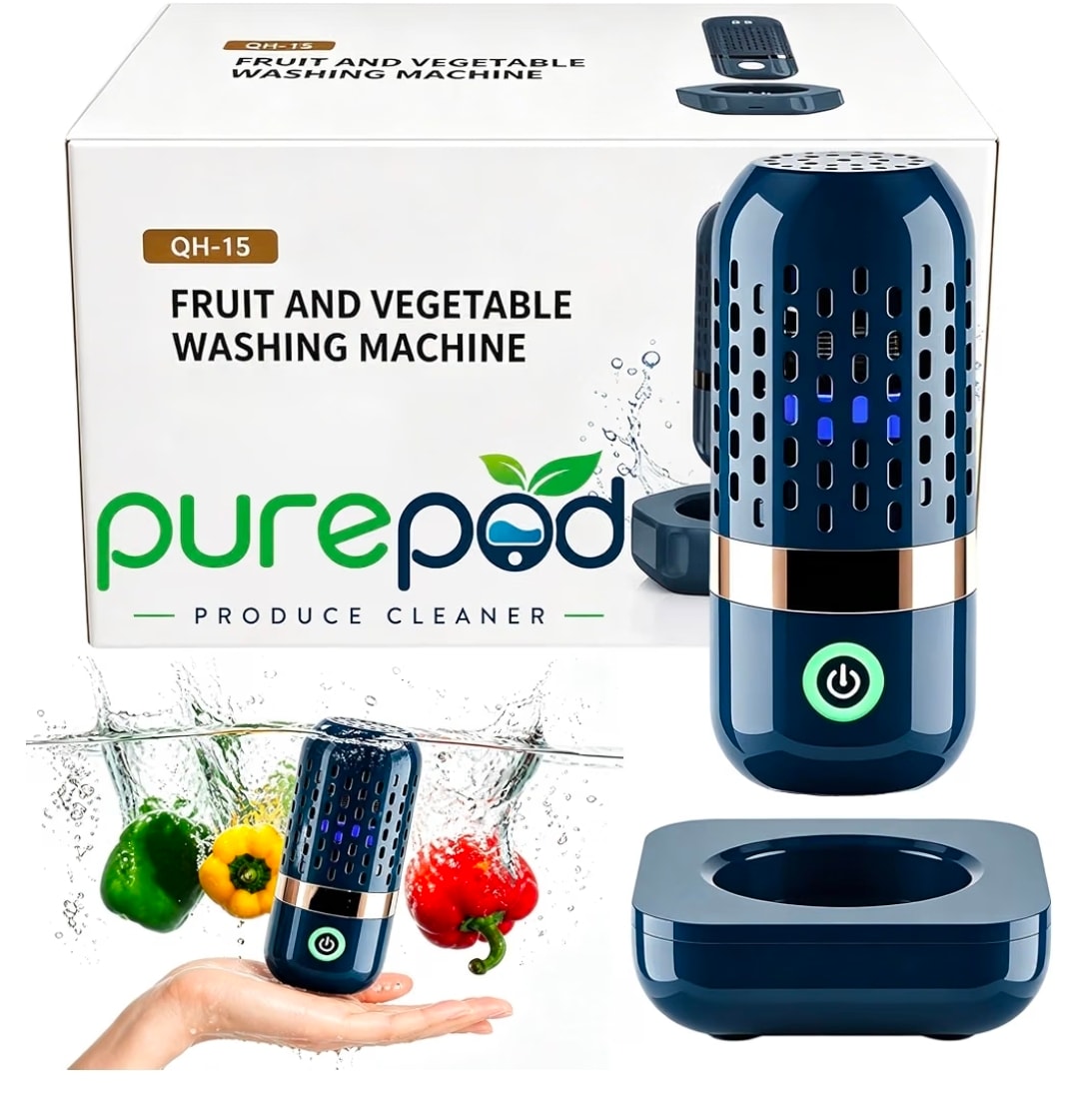
Oh-Ion technology in a bowl of water — no sprays, no chemicals. It removes what rinsing cannot.