That's the Pain Talking: What Living With Everyday Pain Really Feels Like
What living with pain every day does to your nervous system, your sleep and your patience, and why I've learned to say that's the pain talking.

This post contains affiliate links. As an Amazon Associate I earn from qualifying purchases.
There's a version of me who's patient and laughs when the coffee spills. Some days she's here all day. Other days she's gone by ten in the morning, and in her place is a woman with a tight smile and a short answer ready for everything.
That second woman is still me. She's me in pain.
If you've read my other posts, you know pain is part of my everyday life. I'm not going to go into where it all comes from. Today I want to talk about the part nobody sees, the part that's true for so many of us no matter the cause: what living with pain does to a person's mood, why it happens, and how hard it is to explain to someone who has never felt it.
My choice about painkillers
I'll start with something personal. I mostly get through my days without painkillers.
That's my choice for my body, and I've made it for my own reasons.
The first is that I believe painkillers are hard on our organs, even the light, everyday ones. Acetaminophen (Tylenol) is processed by the liver, and taking too much, or taking it often alongside alcohol, can damage it. Ibuprofen and similar anti-inflammatories can irritate the stomach lining and cause ulcers or bleeding, put strain on the kidneys, and raise blood pressure when taken regularly for a long time. Some research also suggests anti-inflammatories may slow the healing of certain injuries, because inflammation is part of how the body repairs itself. When I'm trying to help my body heal, I don't want to add extra work for it.
That doesn't mean I never take them. I do when I truly can't handle the pain, or when I know my body won't get me through the day without help: an 11-hour flight, long days at the computer, or a drive of more than two hours. My goal is to manage those days without them one day. Until then, I take them when I have to and not when I don't.
The second reason is something I learned the hard way, and I think everyone should learn it: listen to your body. Push it, but listen to it. Pain is information. It tells me when I've overdone it, when things are building, or when I need to slow down. I'll be honest, I'm still working on this one, because I have a habit of overriding the signals. I wrote about that in The Day the Body Said No.
Please hear this part clearly: this is not advice. Pain relief is a decision to make with your doctor. Pain medications and the many other treatments available help a great many people live fuller, more comfortable lives, and there's no prize for suffering. I'm only sharing how it goes for me, and being honest that going without has a cost.
A big part of that cost used to be my temper.
Almost 30 years ago, when the pain was new and severe, I found it so hard to cope with how snappy and short I became. Today my family often doesn't even notice when I'm in pain. Over the years I've learned to handle it and to master my temper.
The problem is that people then think the pain is gone. That couldn't be more wrong. What changed is how much pain I can carry, not the pain itself. And I'm still human. Some days I just can't hold it together, and I get snappy and irritated. When that happens, I know I've pushed past what my body can handle, and it will need several days to recover, even if my mood is back to normal the next day. That part is deceiving.
Still, learning to manage my mood has made life easier. It keeps me in a good spiral instead of dragging my family and friends down with me. What I still need to learn is to speak up sooner and say, "Hey, I'm starting to feel my body today, so if I snap, it isn't on purpose." Usually I just handle it quietly on my own and go take those pills.
What's happening in the body
For a long time I thought my snappiness was a character flaw. Then I read about what pain actually does, and began to go easier on myself.
The volume gets turned up. When pain goes on for months or years, research suggests the nervous system can become more sensitive. Doctors call this central sensitization. The same signal gets read as louder, and things that shouldn't hurt much start to.
The alarm stays on. The body answers pain with stress hormones like adrenaline and cortisol. That fight-or-flight response is meant to be brief, but with pain that doesn't leave, you stay a little braced and on guard all day. Anyone who's on guard all day will jump at small things.
Sleep and energy run low. Pain breaks up sleep, and research suggests poor sleep lowers our pain threshold, so the next day hurts more. Managing pain also takes real mental effort, and that energy often comes out of the reserve I'd usually use for patience.
Put all of that together and irritability starts to look like what it is: a symptom, not a personality. It doesn't excuse unkindness, but it explains it, and I find explanations far more useful than shame.
I've also noticed that stress is often my early warning sign. When I catch myself snapping over nothing, I've learned to ask whether my body is trying to tell me that pain is building.
Why it's so hard to explain
Here's the lonely part. Most days, I look fine. I'm smiling, I'm dressed, I made dinner. From the outside, the only sign might be that I'm quieter than usual, a bit sharp, or that I left the party early.
Then there's the pain scale. "On a scale of 1 to 10, how bad is it?" For me, an ordinary day sits somewhere between a 3 and a 6, lower when I keep moving gently and use the things that ease it. When I add what a normal person does, like the gym or housework, it climbs to a 7 or 8. When I've overdone it, it goes to a 9, and honestly some days it feels like it goes past 10. And a 5 that lasts all day, every day, for years is very different from a 5 that's gone by Tuesday.
So I've started just describing it. Sometimes it's a deep ache, like a bruise you can't find. Often it's stiffness, as if my body has been set in plaster overnight and has to be coaxed loose piece by piece. And some days it hurts even when I've done everything "right." That's one of the hardest things to explain, maybe even to myself.
For the people around us
If you love someone who lives with pain, here's what helps, at least for me:
- If someone changes, gently ask. If a person you know starts acting differently, gets snappy or even a little unkind, try not to pull away. Ask them, quietly and without blame, "Are you going through something? I'm here if you want to talk." Then really listen. You may be the first person who asked.
- Ask, don't guess. "How's your body today?" is a kind question. It lets me tell you, so you're not left guessing from my face.
- Try not to take the snappiness personally. It's almost never about you. It's about the ache, the stiffness, the four hours of broken sleep.
- Believe us on the good days. Looking fine and feeling fine are different things.
And there's my part, too. Pain explains my short fuse, but I still own what I say. When I've been sharp, I come back and say so.
My husband has been patient with me through all of this. What I'd love most is to sleep the whole night wrapped in each other's arms like we used to. Some nights my body just won't allow it, and I shift away, stiff and restless. Those nights hurt in a different way. But we've found other ways to stay close. Love learns to adapt, too.
What helps me cope without painkillers
None of these are cures, but together they take the edge off.
Heat. Warmth is my first comfort. A warm shower first thing in the morning helps loosen the stiffness before the day really starts, and on hard evenings a heating pad is pure relief. And here's a confession: my most-used pain reliever is the heated seat in my car. I turn it on even when it's 100°F outside, just on the lowest setting, and let the gentle warmth ease my back while I drive.
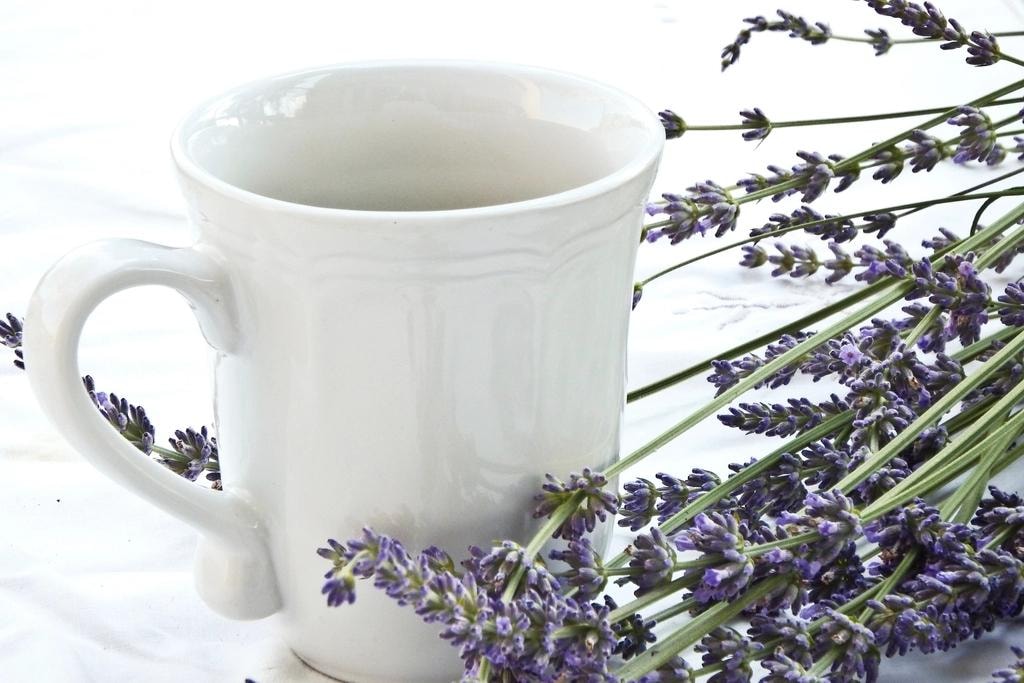
A good option from my shop: the inngi Lavender Microwavable Neck Wrap Set with Eye Pillow. It drapes over the neck and shoulders, there's no cord to worry about if you doze off, and the eye pillow is lovely at the end of a long day. Heat it a little at a time and follow the instructions.
Gentle movement. Slow stretches and short, easy walks. Movement is often the last thing I feel like doing, and usually the thing that helps most. Gentle and regular beats pushing hard on a good day.
Restorative yoga is another gentle option I find soothing. You rest in a few supported poses for several minutes each, with bolsters, pillows and blankets doing the work so your muscles don't have to. Look for a class labeled gentle or restorative, go at your own pace, and check with your doctor or physio first.
A good option: the ECOGA Cork Yoga Mat (5mm). It's natural cork on a cushioned rubber base, grippy without being sticky and gentle on joints, and it comes with a carry strap and canvas bag. You can also find it in my shop.
For a calming scent, do what many yoga teachers do: put one drop of Plant Therapy Lavender Essential Oil in your palms, rub them together and breathe it in as you rest at the end. A light mist of ASUTRA Peaceful Lavender Yoga Mat Spray on your mat before you start does the same job. Keep essential oils away from your eyes, dilute them before putting them on skin for longer, and go easy around pets, especially cats.
Protecting my sleep. A cool, dark room and a regular bedtime. On the nights I sleep better, the next day really is easier on everyone.
From my shop: a warm bath before bed can help you wind down. Dr Teal's Pure Epsom Salt Soothe & Sleep with Lavender is a good option for a relaxing soak.
Tracking stress. Since stress is often my first warning sign, I wear a ring and watch that track sleep and heart rate variability. When my numbers dip for a few days, I take it as a nudge to rest before my body forces me to.
This is the kind I use: an Oura Ring 4 and a Samsung Galaxy Watch 8. You'll find the newer Oura Ring 5 (plus its free sizing kit) and the Galaxy Watch 9 in my shop. Oura uses its own sizing, so try the sizing kit first.
Anti-inflammatory food. You know this is close to my heart. Colorful vegetables, oily fish, olive oil, beans and whole grains. Food doesn't erase the pain, but it's part of the foundation.
A good option if you want an omega-3: Nordic Naturals Ultimate Omega is in my shop. Check with your doctor before starting any supplement.
Pacing. I spread tasks out, take breaks before I need them, and say no more often, so I have some energy left for the people I love.
A gentle closing
If you live with pain and have been hard on yourself for being short-tempered, I hope this gives you room to breathe. Your nervous system is working overtime; you're not a bad person. And if you love someone in pain, thank you for reading this far.
I'm still learning. Some days I'm the patient woman who laughs when the coffee spills. Other days I'm the one who has to come back and say, "I'm sorry, that was the pain talking." Both of them are me, and I'm learning to be gentle with both.
My comfort shelf
Most of what I mentioned above, including the ECOGA cork mat, the Oura Ring 5 and the Samsung Galaxy Watch 9, is waiting in my shop: mrsedwardskitchen.com/shop.
Medical disclaimer: I'm sharing my own experience, not medical advice. Everyone's body and situation are different. Please talk with your doctor before changing how you manage pain, starting or stopping any medication, or trying new supplements or routines.